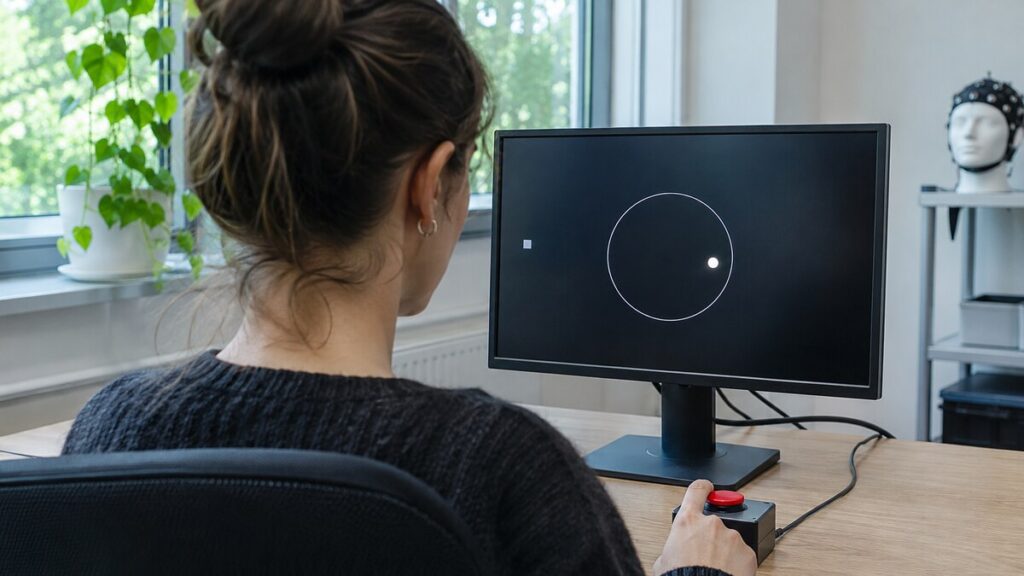
Keep a moving dot inside a circle. Easy enough, until a number flashes at the edge of the screen and you also have to decide whether to press a button. Look away from the dot and it drifts. Concentrate on the dot and you may miss the number altogether. If you did this exercise after taking THC, the revealing part might be which half of the task you chose to protect.
Two jobs and one score too few
Researchers use versions of this exercise to study divided attention. The two activities give them separate records. One shows how far your cursor strayed from its target. The other shows which signals you detected, which you missed and how quickly you responded. A participant who sacrifices tracking accuracy to catch every signal can look remarkably sharp if the report gives only reaction times.
The opposite problem arises if an experiment records only correct responses. Suppose someone hits the button for every flash, including numbers they were supposed to ignore. Their hit rate will be excellent. Their false alarms tell a different story. These elementary distinctions matter when reading a review of controlled THC experiments. It examined several abilities involved in driving and found evidence of acute impairment on divided-attention tasks. That finding concerns a particular demand on attention. It does not specify which everyday distraction any one person will miss.
What changes when the second job disappears?
Imagine running the tracking exercise on its own, then adding the numbers. If someone’s hand already moves more slowly in the first condition, some of the delay in the second may have very little to do with dividing attention. A comparison between single and combined tasks gives the investigator a way to ask where the extra difficulty appeared. Even then, slowing down can be a deliberate choice. A volunteer might trade speed for accuracy the moment the exercise begins to feel difficult. A comparison of divided-attention tasks after smoked, vaporized and oral cannabis illustrates why the task and method of administration both belong beside the score.
Could a phone pick up the difference?
A laboratory can give a volunteer a long practice session, a large monitor and an uninterrupted hour. A test meant for a phone has to earn every minute of the user’s time. Researchers exploring phone-based measures after oral THC took that problem seriously by testing brief computerized exercises alongside more conventional measures. A task can be convenient to administer and still be poorly suited to detecting the change of interest.
Consider what happens if a sober volunteer can complete a short test almost perfectly. A few extra mistakes may stand out. But if there are only a handful of trials, one accidental tap also matters enormously. Lengthening the test gives the investigator more observations while changing the experience for the volunteer. Sustaining concentration through a tedious exercise is itself a demand on attention. The choice of test length quietly changes the question.
Time since exposure belongs on the score sheet
A result obtained during one visit is a snapshot. In studies that follow volunteers over several hours, a drug’s effects can change while the volunteers are also getting better at the task. Testing under placebo on a separate occasion helps investigators estimate how much of the improvement comes with practice. Research comparing oral and vaporised THC on driving-related cognitive tasks illustrates another reason to record the clock. Two people tested an equal number of minutes after administration need not be at comparable points in their response.
The most informative account of that moving dot would let you watch both traces. Perhaps the cursor still hugs the target, but half the numbers pass unnoticed. Perhaps every number gets an answer, three of them wrong. Both patterns could disappear behind a headline saying attention declined. The experiment becomes intelligible when you can see what the participant was asked to attend to, what else was competing for that attention, and exactly how the investigator noticed a lapse.